
Our Thinking
The Seventh Layer: Where Value Accrues When Intelligence Is Free
In 2026 the AI industry is usually described as a stack. The habit comes from the internet era, when we learned to read a technology as a sequence of layers, each with its own chokepoints and its own economics. Chamath Palihapitiya's May 2026 deep dive at Social Capital's Learn With Me draws six of them: infrastructure, chips, data, models, execution, and application. His argument is that once the boundaries are drawn correctly, one can see which layers will compound value and which will be commoditized.
I find the map sound. I also think it is incomplete by one layer.
Each of the six layers produces something measurable: power, compute, tokens, predictions, actions, interfaces. An enterprise pays for none of these for their own sake. It pays for better commitments. A budget gets moved, a market gets entered or abandoned, a product gets killed a quarter earlier than it would have been otherwise. Value in a company is realized at the moment a possibility becomes a decision that someone owns, and it is realized a second time when the world reports back on whether the decision was sound.
I call that moment the seventh layer. It is the point where model output turns into enterprise commitment. It receives less capital than any other layer in the stack, and my view is that the fulcrum assets of the next decade will sit there. Anyone who says this in public owes an answer to the obvious follow-up question, which is what the moat could possibly be in selling better decisions when the models underneath are commodities. I will try to give that answer.
Where the capital sits
Begin with the flow of money. Gartner now expects worldwide AI spending to reach about $2.67 trillion in 2026, an increase of 49.5% over 2025. Roughly $1.48 trillion of that, or about 56%, goes to infrastructure. Spending on generative AI models themselves is forecast at $28.3 billion, about 1% of the total, according to the same Gartner forecast as reported by THE Journal.
The bottom of the stack is concentrated and capital-intensive, so it is unsurprising that the infrastructure story dominates the coverage. The same concentration explains why Gartner has warned that more than $3.5 trillion of AI infrastructure spending could be exposed to impairment by 2030. Its forecast puts attributable enterprise and consumer AI revenue over that period at no more than $3.6 trillion, against roughly $7 trillion of provider investment.
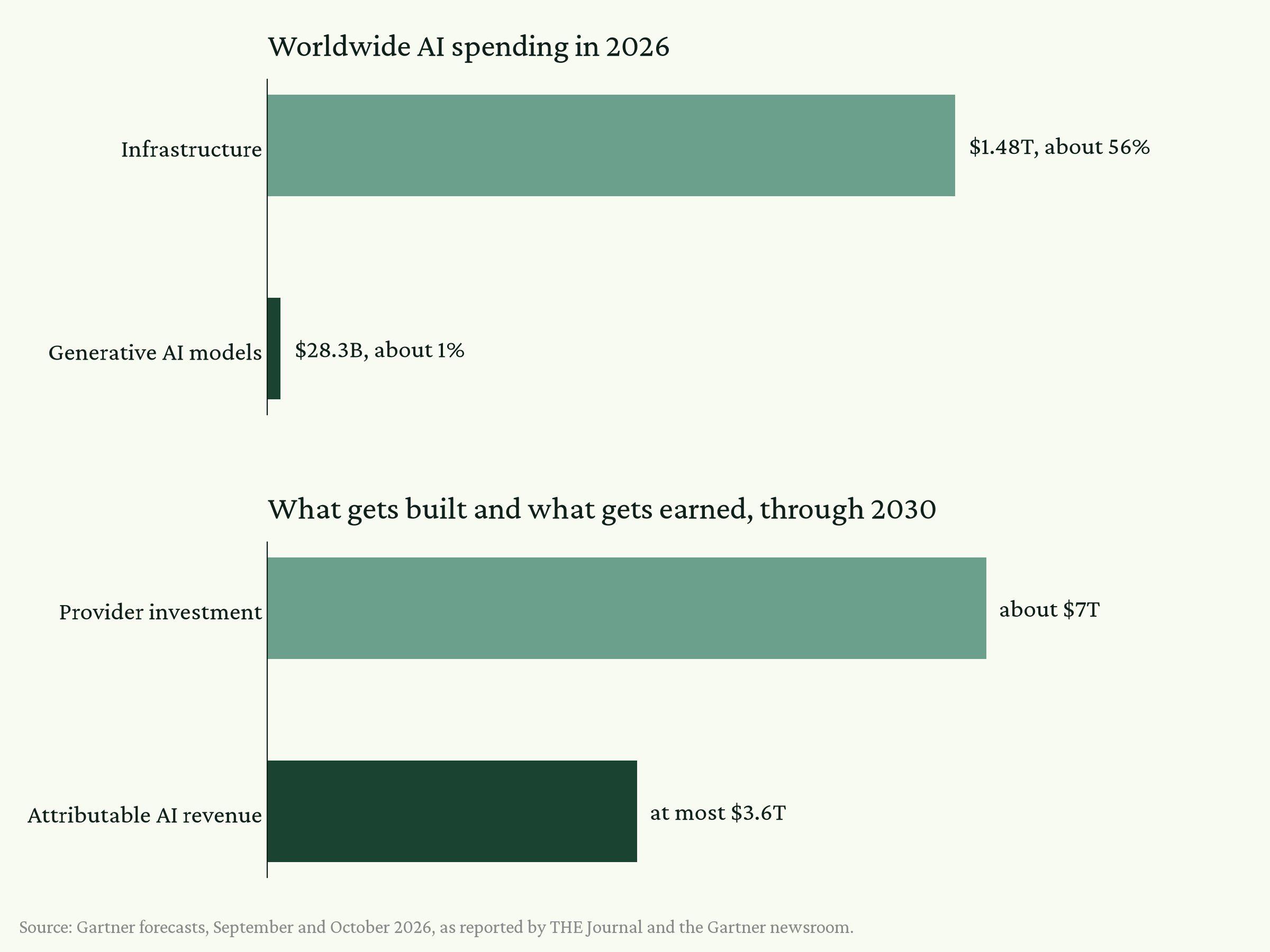
I regard that gap, between what is being built and what is being earned, as the central fact of the period. The revenue has to be earned somewhere above the silicon. Where it will be earned remains an open question.
The falling price of thought
The middle of the stack is deflating faster than anything we have tracked. Epoch AI finds that the price of reaching a fixed level of model performance has fallen about 47% per quarter, or 13x per year. By their measure, LLM inference has become cheaper four times faster than DNA sequencing, six times faster than compute, and 54 times faster than electricity. Earlier Epoch work found declines between 9x and 900x per year depending on the task, with a median of 50x.
When a resource becomes 13 times cheaper each year, possessing it confers less and less advantage. The advantage moves to whoever knows what to do with it. Intelligence is trending toward free. The judgment about which intelligence to trust, and what to commit to on its basis, shows no sign of following it down.
The missing returns
If the stack worked end to end, cheaper intelligence would by now be visible in enterprise results. For the most part it is absent.
McKinsey's latest global survey finds that 37% of respondents attribute any EBIT impact to AI, a figure essentially unchanged from the year before, and the share of "AI high performers" has held at about 6%. The 2025 edition found that among those who reported any impact, most attributed less than 5% of EBIT to AI.
The largest executive survey on the question agrees. In the NBER paper "Firm Data on AI", nearly 9,000 CFOs, CEOs, and senior executives across seven countries report that AI has raised annual labor productivity growth by about 0.2% over the past three years. The effect is modest, though the same executives expect it to triple.
MIT's Project NANDA reported a starker result. Despite $30 to $40 billion in enterprise generative AI investment, 95% of organizations in its study saw no measurable P&L impact. The number should be handled with care. The report is preliminary, and critics have pointed out that "no measurable impact" often describes pilots that never established a baseline before deployment. I read that caveat as the more important finding. An organization that cannot state what a decision was meant to change has no means of learning whether the change occurred. I would classify that as a missing layer in the stack, and I would resist filing it away as a footnote about measurement.
The agentic wave meets the same obstacle from the opposite side. In 2025 Gartner predicted that over 40% of agentic AI projects would be canceled by the end of 2027 because of escalating costs, unclear business value, or inadequate risk controls. In May 2026 it went further and predicted that by 2027, 40% of enterprises will demote or decommission autonomous AI agents because of governance gaps discovered only after production incidents. These systems had shipped. They acted in production, and they were withdrawn afterward because no one had governed the moment at which an action became a commitment.
Same tools, different results
The strongest causal evidence I know of on this question comes from a field experiment. Researchers from INSEAD and Harvard Business School gave 515 high-growth startups identical AI tools, API credits, and technical training. A randomly selected half were also shown how other firms had reorganized their production around AI. That half found 44% more AI use cases, were 18% more likely to land paying customers, and generated 1.9x the revenue of the control group, while asking for less outside capital.
The authors call the bottleneck the "mapping problem," which they describe as discovering where and how AI creates value within a firm's production process. Chamath's own follow-up piece arrives at a similar place, arguing that AI can return time but cannot decide how people use it. Hours reclaimed by automation and then spent on additional meetings and sign-offs produce a return of zero.
In that experiment the tools were held constant across both groups, so the tools cannot explain the difference in outcomes. What differed was the set of decisions about where to point them.
The cost of deciding
Executives have long sensed that decisions are where the cost resides. McKinsey estimated that managers spend 37% of their time making decisions and that more than half of that time is used ineffectively. For a typical Fortune 500 company this comes to roughly 530,000 lost manager-days and about $250 million in wages each year.
Inconsistency carries its own cost. In the noise audit that gave rise to Kahneman, Sibony, and Sunstein's book, executives at a large insurer expected two underwriters pricing the same case to differ by about 10%. The median difference was 55%. The organization had no idea it had the problem.
AI enters this picture by making another analysis, another forecast, or another agent's recommendation nearly free to produce. If nothing governs which of those signals becomes a commitment, cheaper intelligence will enlarge the noise problem.
Precision and disagreement
Most "single source of truth" strategies fail at this point, usually without anyone noticing, and the reason can be stated exactly.
Treat any organizational decision as an action chosen on the basis of some model of the world. The model might be an attribution model, a forecast, a segmentation, or an agent's chain of reasoning. By the law of total variance, the variance in what the organization ends up doing splits into two parts:
Term 1
Uncertainty within each model
Term 2
Disagreement between models
Better data, better models, and better measurement reduce the first term. They leave the second untouched, and cheap intelligence tends to inflate it, since every team can now run its own equally defensible model. Our research at Amoeba formalizes the condition under which this occurs. When the number of decision-distinct representations grows faster than the evidence available to distinguish among them, disagreement about what to do persists or grows, even as each individual system becomes more precise. The result is conditional, and it has boundary cases in which the paradox collapses. It does, however, describe most of the strategic decisions an enterprise makes, which are made once, with contested causes, and without a clean counterfactual.

Canonical truth is the correct goal for ledgers, inventory, and compliance, the operational "what." For the strategic "why," I think it is the wrong goal. Those decisions need a representation suited to the particular decision, explicit about what the evidence does and does not support, and open to correction by what happens next.
Plumbing and poetry
The single source of truth fails for a second reason, and this one has nothing to do with statistics.
James March once described leadership as a "delicate combination of plumbing and poetry." INSEAD's Gianpiero Petriglieri opens a new essay in Academy of Management Learning & Education with that line, and with Marcel Duchamp's Fountain, the factory-made urinal that Duchamp called a "readymade," an everyday object "raised to the dignity of a work of art by the artist's act of choice." Petriglieri argues that leadership works in the same way. He treats it as an intentional act of choice, made in front of a group of people, within a particular culture, at a particular moment, and he declines to reduce it to mastery of a skill set.
I find this a useful lens on the stack. Model output is becoming a readymade. It is mass-produced, nearly free, and sold to every competitor at the same price. Its value comes from the act of choice that places it on the pedestal: this forecast over that one, this market over the other, this budget moved and this program ended. The six layers are the plumbing. The seventh is where the choosing happens.

Petriglieri describes three positions from which a person can work. The first he calls drive. Here we do what our history taught us and what the environment rewards, and he associates it with the artisan. The second is insight, in which we step back and analyze the system without a personal stake, as a critic or analyst would. Only the third, intent, belongs to the leader. It means remaining engaged with both the organization and one's own judgment, taking neither for granted, and trying to reshape both.
Set beside the AI stack, the pattern is unflattering. Agents are being built to automate drive, which means executing the workflow and optimizing whatever the system already rewards. Models are being built to automate insight, which means detached analysis at near-zero marginal cost. Almost nothing in the stack is built for intent, the place where someone declares what they are trying to bring about and stakes something on it.
Petriglieri names the shift. The third movement of leadership, he writes, runs "from prediction to intervention," from the analyst, who "takes the world for granted as it is and attempts to predict the odds that a certain action might result in a certain outcome," to the leader, who "imagines the world as it could be and attempts to change the odds." AI has made prediction abundant. Intervention has become no easier. A flood of plausible predictions probably makes it harder, because every option now arrives with a well-argued case attached.
He also raises a caution that I take seriously, given what Amoeba builds. He grants that "technical and economic frameworks cannot fully capture" what leadership is or account for its value, and he suggests there may be no such thing as evidence-based leadership. I agree that the commitment layer should neither measure the leader nor replace judgment. Its job is narrower, and I believe more honest. It makes the act of choice visible: what was chosen, on what evidence, with what intent, and what the world said in return. It holds commitments to account and leaves the choosing to people.
The seventh layer, defined
Here, then, is the layer I would add to the map.
The job description of the commitment layer is short. Models propose, auditable reasoning determines what the evidence supports, and outcomes correct both. The layer sits at the boundary where a possibility shaped by a model becomes an enterprise action with a cost, an owner, and a consequence. It checks the action before commitment, records what was committed and why, and binds the commitment to the outcome it was meant to move. It then allows the outcome to revise the instruments, including the layer's own thresholds, metrics, and assumptions.
The last clause carries the most weight. A governance layer that cannot be corrected by the world it governs will simply be wrong with more confidence and more sophistication than before.
In Petriglieri's vocabulary, this layer exists to protect intent from the two positions that tend to crowd it out. Without it, organizations drift toward drive and let agents carry out whatever the incentive system already rewards, or they retreat into insight and commission one more analysis in place of a commitment. The commitment layer keeps in front of leadership the question he says every leader must eventually face: am I using this capability to satisfy the system's drive, to stand outside it and critique it, or to honor an intent for it?
The fulcrum assets
In the Social Capital framework, a fulcrum asset is a single point that every unit of value above it must pass through. I see three at the commitment layer.
1. The work-to-outcome graph. Most enterprises can describe what their teams are doing, and separately they can describe how the business is performing. Very few can show which work was intended to move which outcome, how those outcomes affect one another, and where the portfolio is drifting away from leadership's stated objectives. The INSEAD and Harvard experiment is in effect evidence of what happens when firms obtain even a partial version of this map. The same tools, pointed more carefully, produced nearly twice the revenue.
2. The commitment record. Foundation Capital has argued persuasively that the next systems of record will capture decision traces, meaning the exceptions, approvals, and precedents behind an action, and that these traces will accumulate into a "context graph." I agree that the "why" must become first-class data. A trace of how a decision was made, however, remains a record of the past. Perfect recall of every past exception cannot tell you which of the forces behind those exceptions still hold today. That requires discernment, which memory alone does not supply.
3. The outcome binding. This asset compounds, and it cannot be copied after the fact. When every commitment is tied to the outcome it was meant to move, the organization accumulates something no model vendor can sell it: a calibrated, organization-specific record of which kinds of evidence predicted which kinds of results. The record improves each subsequent decision. Its value rises as model prices fall, because every cheap new signal can be weighed against the organization's own history of what worked.
Decision traces describe what happened. The commitment layer is meant to say whether it should happen again.
The asset has a human analogue. Petriglieri distinguishes "friends of performance," who reward us for doing what we have always done, from "friends of learning," who challenge us and hold us to the person we are trying to become. Most enterprise analytics behave as friends of performance. Dashboards confirm the plan, attribution models credit the programs that were already funded, and agents accelerate the workflow that already exists. A commitment record bound to outcomes behaves more like a friend of learning. It remembers what you said you were trying to do, and it tells you when the world disagreed.
He also proposes a test for any intervention, which is whether it is "imposing or inviting." The test applies to systems as readily as to leaders. A commitment imposed by an opaque recommendation is obeyed until it fails. A commitment whose reasoning is visible invites the people carrying it out to examine it, extend it, and correct it. Only the second kind produces an organization that learns.
The question of the moat
A good deal of cynicism surrounds anyone selling decision intelligence at the moment, and I share some of it. The skeptic's case runs as follows. Models are a commodity, so anything built on them is a wrapper. Data has stopped being a moat, because agents can extract it from any system that exposes an API. Decision traces, the newest candidate, are logs with better branding. Forrester's Charles Betz states the last point most sharply. Context graphs, he argues, are "a convergence, not an invention," built on decades of enterprise architecture, configuration databases, and process mining. "Persistence is never the hard part," he writes. "Fidelity is." Without governance, the graph "becomes a write-only log" and agents "learn from stale precedents."
The cynic is largely correct, and it is worth being precise about where. The model offers no moat. In our own system it is deliberately the most replaceable component. Middleware offers none either, since connecting to an enterprise's systems is a minimum requirement. The dashboard offers none, because it is a friend of performance. The mathematics, taken alone, offers none. It indicates what to collect and how to weigh it, and anyone can read a theorem. Incumbents say much the same about themselves. At Sapphire this year, SAP's Christian Klein said the company's long-term moat would come from trusted operational data, embedded process logic, and governance infrastructure, and he placed the AI models themselves outside that list.
The location of the moat follows from the variance decomposition. The second term, disagreement between models, does not shrink as models improve. It shrinks only when the organization observes outcomes that its competing representations predicted differently. Treat each representation as a hypothesis about how the business works. Its weight updates with each commitment and the outcome that follows.
Two consequences follow, and together they constitute the argument. The first is that without binding there is no update. A forecast that was never acted on, or an action whose outcome was never tied back to it, teaches the organization nothing about which model deserves trust. The second is that an outcome every representation predicted identically carries no information. The evidence that resolves disagreement comes from commitments made where representations diverge, recorded with what was chosen and what was declined, and graded later.

The moat, then, is an outcome-graded record of commitments made against a stated intent. It is a narrower and rarer thing than data in the ordinary sense. It is the specific evidence that shrinks the second term, the evidence that the Versions of Truth condition says must grow faster than the representations competing for belief. Four properties make it difficult to copy.
It is time-locked. Strategic outcomes arrive over quarters. A budget reallocation made this spring may not be gradable until next year. Such a record cannot be backfilled, purchased, or synthesized. A competitor that begins eighteen months later is eighteen months of graded decisions behind, regardless of which model it licenses. In a stack where intelligence becomes 13 times cheaper each year, a moat made of elapsed time is one of the few that deflation cannot wear down.
It requires a seat in the room. Betz observes that the traces captured by today's tools are "overwhelmingly grounded in digital artifacts," while many of the most consequential decisions take place in meetings that may leave no notes, which leaves their reasoning as "dark matter." He is right, and the point is central. The important decisions cannot be mined from chat logs. The record exists only if the system is present where strategy is set and reviewed: the leadership meeting, the operating review, the morning briefing, in whatever form a given executive actually reads or listens to. That presence has to be earned through usefulness well before the first outcome is graded. For that reason, the first thing a commitment layer delivers has to be a map of the organization that executives choose to open.
It is anchored to intent. A log records what happened. A commitment record must also know what you were trying to make happen. That requires representing the strategy itself, meaning the objectives a leadership team sets, and mapping all the work that costs money against it. The work includes every program, event, and campaign, along with the hidden work that consumes budget without appearing on any plan. Only then can one ask whether five initiatives aimed at a single goal reinforce or cannibalize each other, and only then does an outcome carry meaning. An outcome without a declared intent is an anecdote. In Petriglieri's terms, drive leaves traces everywhere, while intent must be stated before it can be graded.
It compounds across organizations. Within a single company, strategic decisions are few, confounded, and slow to resolve, and an honest system should cap its own confidence accordingly. Across many companies, patterns appear that none could see alone: which kinds of commitments, under which conditions, tend to move which kinds of outcomes. A cross-enterprise record of how markets are actually made does not yet exist. It is also what the next generation of agents will need before anyone can sensibly trust them with consequential decisions. Models trained on text know how people talk about strategy. None has yet observed, at scale, which strategies worked.
The closest precedent I know is credit scoring. The formula was never the asset. The asset was a long history of lending decisions, each eventually graded as repaid or defaulted, each improving the next. Strategic decisions have never had that loop. Whoever builds it will hold something that models cannot reproduce and falling prices cannot cheapen.
For anyone evaluating a vendor of decision intelligence, ourselves included, five questions separate decision infrastructure from decision theater.
- Does it know what you are trying to achieve, in your own words, before it shows you anything?
- Does it record what you decided, including the recommendations you declined?
- Is each commitment bound to an outcome, and to a window for judging it, stated in advance?
- If you swapped the underlying model tomorrow, would it keep what it has learned?
- Will it tell you, on a date you can check, that it was wrong?
A system that fails any of these is selling insight, and insight is the part of the stack that is becoming free.
An early category
The category already exists in early form. Gartner published its inaugural Magic Quadrant for Decision Intelligence Platforms in January 2026 and described a market that has "shifted from niche adoption to a late-stage emerging market." The leaders it named, among them FICO and SAS, are strongest where decisions are high-volume, repeatable, and governed by explicit rules: credit, fraud, pricing, supply chain.
Those are operational decisions. The strategic ones, such as a CMO reallocating a budget or a CRO redrawing territories, remain largely unserved. They are made infrequently, they rest on contested causal stories, and they are precisely where multiplicity does the most damage.
Marketing as the test case
Marketing shows the missing layer more clearly than any other single function.
Gartner's 2026 CMO Spend Survey finds marketing budgets effectively flat at 7.8% of company revenue, with CMOs allocating an average of 15.3% of those budgets to AI and only 30% reporting mature AI readiness. Gartner also notes that the average budget is 18% below the mean allocation of four years ago.
MIT's NANDA research supplies the irony. More than half of generative AI budgets go to sales and marketing tools, while the largest measured returns came from back-office automation.
Marketing has no shortage of intelligence. It has attribution models, intent data, brand trackers, search data, pipeline data, and now agents producing content and analysis at near-zero marginal cost. It lacks the layer that connects all of this to a small number of consequential commitments, shows which commitment changed or ought to change, and learns from the result. Amoeba is bringing its decision-intelligence platform to marketing leaders first for that reason. The distance between abundant signal and the quality of commitment is widest there.
Predictions
A map earns its keep by making predictions that can be checked. Mine follow, stated so that they can fail.
- "Which decision changed?" becomes a procurement question. By the end of 2027, a growing share of enterprise AI contracts will include acceptance criteria tied to a named decision and a pre-registered outcome, alongside usage or task completion. Buyers, more than vendors, will close the baseline gap that MIT identified.
- Decision design will explain the high-performer gap better than AI spend. When researchers study what separates McKinsey's roughly 6% of high performers from everyone else, measures such as decision latency, reversal rate, and outcome-binding coverage will account for more of the gap than model choice or budget share.
- Governance moves from the gate to the loop. The agents that survive Gartner's predicted wave of decommissioning will be those whose commitments are recorded, reversible, and bound to consequences. The strictness of their approval workflows will matter much less.
- Decision records become audit artifacts. Boards and regulators will increasingly ask what the organization committed to on the basis of an AI system's recommendation, who owned that commitment, and what happened next, in addition to what the system recommended.
- Intervention becomes the scarce executive skill. As models absorb more of the analyst's work, leadership development and executive hiring will place more weight on the ability to state an intent, commit to it publicly, and revise it when the evidence turns. This is the movement from prediction to intervention that Petriglieri describes.
- Decision intelligence divides into graded and ungraded. By the end of 2028, decision tools unable to show an outcome-graded record of commitments will be absorbed as features into model providers and systems of record. The independent survivors will be those whose recommendations are scored against what actually happened.
If these do not come to pass, my thesis is wrong, and value will continue to accrue lower in the stack.
The layer that prices the others
Each era of computing was won by those who read the stack correctly. The internet's map ran from physical wires to applications, and the durable companies sat on its boundaries. The AI map is still being drawn, and its lower layers are being claimed with trillions of dollars of capital.
Intelligence, meanwhile, is becoming a commodity faster than any input we have measured. Under those conditions the scarce thing is the accountable commitment: a decision someone owns, made on evidence that can be inspected, and bound to an outcome capable of correcting it.
That is also my answer to the cynic. The moat lies in the record of what was chosen, against what intent, and what the world said back. It accumulates at the rate time passes, and no amount of money buys a place at the front of it.
Duchamp's urinal was an ordinary object, and the act of choice gave it its meaning. AI is turning intelligence into the most abundant readymade in history. Value will go to those who make the act of choice well and who allow the world to tell them when they chose badly.
That is the seventh layer. The other six are plumbing. The poetry is here, and so, in the end, is the payment for every layer beneath it.