
Our Thinking
Intelligence is trending toward free.
The judgment about which intelligence to trust, and what to commit to on its basis, shows no sign of following it down. Value accrues at the seventh layer, the decision intelligence layer, where model output turns into enterprise commitment.
The map
The six layers are the plumbing. The seventh is where the choosing happens.
Each layer of the AI stack produces something measurable: power, compute, tokens, predictions, actions, interfaces. An enterprise pays for none of these for their own sake. It pays for better commitments.
Value in a company is realized at the moment a possibility becomes a decision that someone owns, and it is realized a second time when the world reports back on whether the decision was sound.
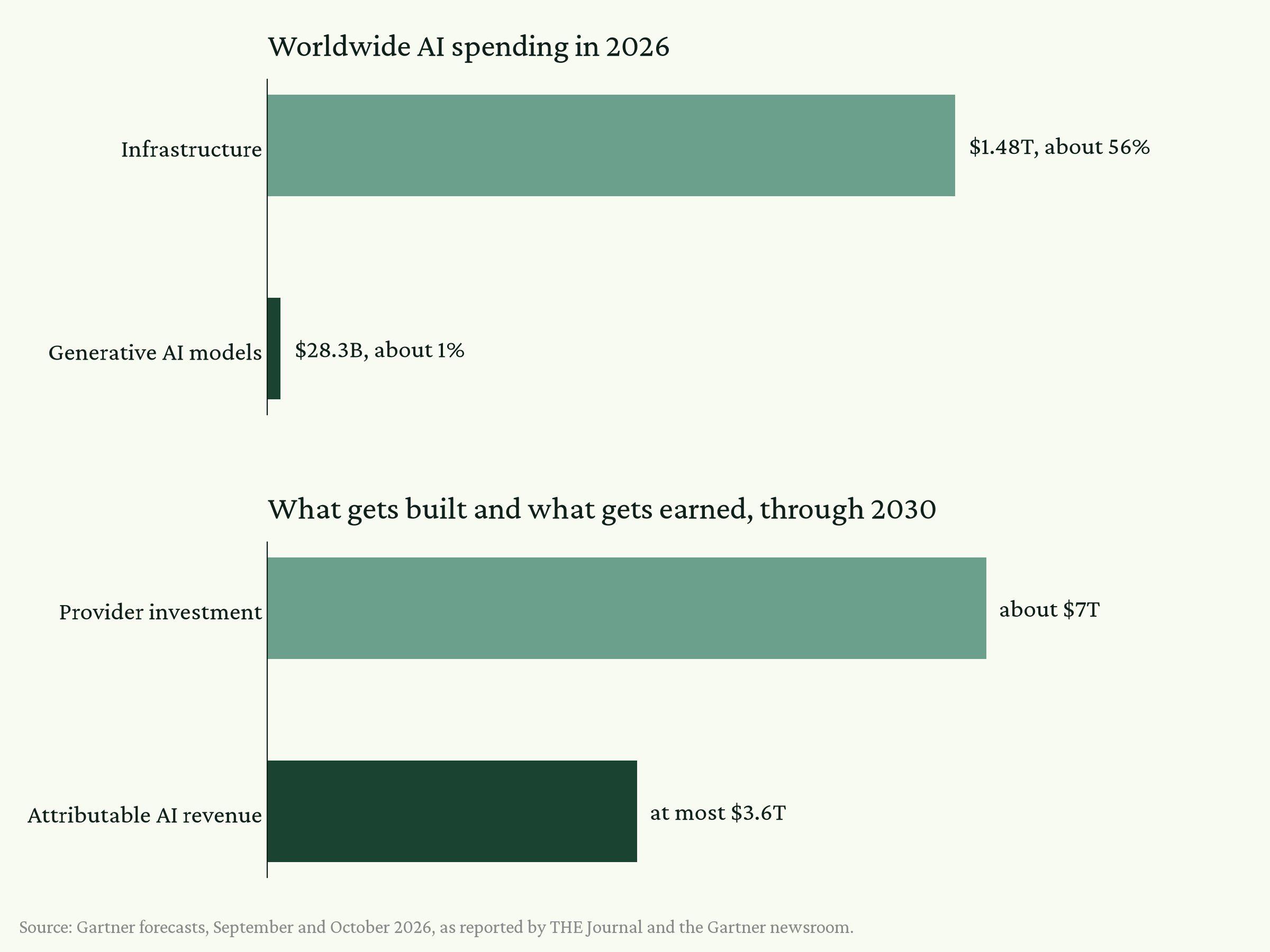
The gap, in numbers
The revenue has to be earned somewhere above the silicon.
Roughly $7 trillion of provider investment is set against no more than $3.6 trillion of attributable AI revenue through 2030. Cheaper intelligence has not yet shown up in enterprise results.
6%
The share of organizations McKinsey counts as AI high performers, unchanged year over year.
McKinsey55%
The median gap between two underwriters pricing the same case, where executives expected 10%.
The noise auditPlumbing and poetry
Almost nothing in the stack is built for intent.
Model output is becoming a readymade: mass-produced, nearly free, and sold to every competitor at the same price. Its value comes from the act of choice that places it on the pedestal. Gianpiero Petriglieri describes three positions a leader can work from. The AI stack is automating two of them.

Drive
Doing what our history taught us and what the environment rewards.
Agents are being built to automate it.
Insight
Stepping back to analyze the system without a personal stake.
Models are being built to automate it.
Intent
Declaring what you are trying to bring about, and staking something on it.
This is the seventh layer.
Precision and disagreement
Better models shrink one term. Only outcomes shrink the other.
By the law of total variance, what an organization ends up doing splits into uncertainty within each model and disagreement between models. Better data, better models, and better measurement reduce the first term. Cheap intelligence tends to inflate the second, since every team can now run its own equally defensible model.
Term 1
Uncertainty within each model
Shrinks with better data and models
Term 2
Disagreement between models
Shrinks only with observed outcomes


The question of the moat
An outcome-graded record of commitments made against a stated intent.
The model offers no moat, and neither does middleware or the dashboard. Disagreement between models shrinks only when an organization observes outcomes its competing representations predicted differently. Commit, see the outcome, update. Four properties make that record difficult to copy.
01
It is time-locked.
Strategic outcomes arrive over quarters. The record cannot be backfilled, purchased, or synthesized, and deflation cannot wear it down.
02
It requires a seat in the room.
The important decisions cannot be mined from chat logs. The record exists only where strategy is set and reviewed.
03
It is anchored to intent.
A log records what happened. A commitment record must also know what you were trying to make happen.
04
It compounds across organizations.
Across many companies, patterns appear that none could see alone: which commitments, under which conditions, move which outcomes.
Predictions
Founder's predictions
A map earns its keep by making predictions that can be checked. If these do not come to pass, the thesis is wrong, and value will continue to accrue lower in the stack.
1
"Which decision changed?" becomes a procurement question.
By the end of 2027, more enterprise AI contracts will tie acceptance criteria to a named decision and a pre-registered outcome.
2
Decision design will explain the high-performer gap better than AI spend.
Decision latency, reversal rate, and outcome-binding coverage will account for more of the gap than model choice or budget.
3
Governance moves from the gate to the loop.
The agents that survive will be those whose commitments are recorded, reversible, and bound to consequences.
4
Decision records become audit artifacts.
Boards and regulators will ask what was committed on an AI system's recommendation, who owned it, and what happened next.
5
Intervention becomes the scarce executive skill.
Leadership hiring will weigh the ability to state an intent, commit to it publicly, and revise it when the evidence turns.
6
Decision intelligence divides into graded and ungraded.
By the end of 2028, tools without an outcome-graded record of commitments will be absorbed as features.
Further reading
The Demon in the Machine
A three-part essay series on Substack about AI, knowledge, and what systems can and cannot know.
The full essay
The Seventh Layer: Where Value Accrues When Intelligence Is Free
By Tooba Durraze, Founder and CEO, Amoeba AI