The Seams
A study of why honest measurement systems inside one organization produce different numbers, and where that disagreement sits.
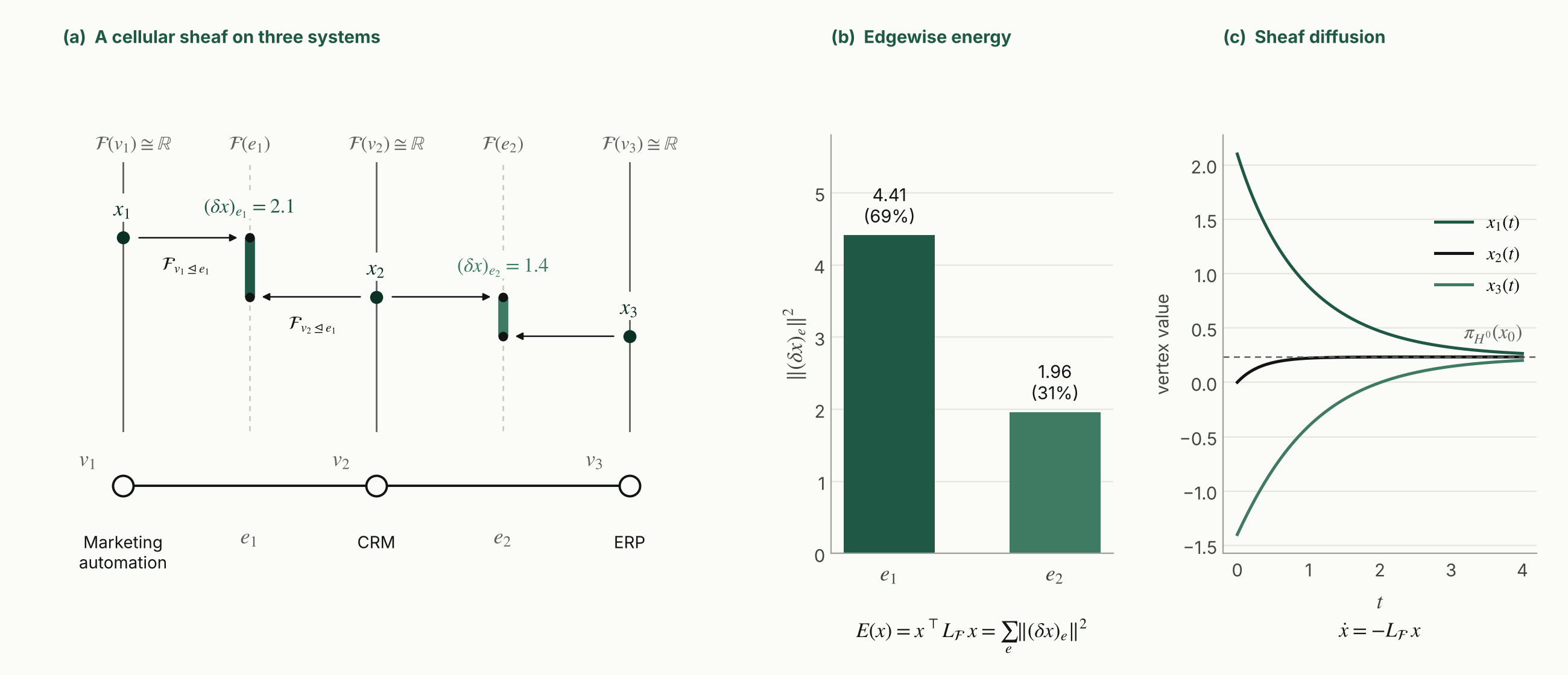
When an organization has several defensible ways of measuring the same reality, how does it decide what to believe enough to act on? We model an organization's systems as a cellular sheaf: systems are nodes, handoffs are edges, and the definitions applied at each handoff are restriction maps. Using established results in the spectral theory of sheaves, we show how disagreement can be measured and located edge by edge, how some conflicts are structural and cannot be resolved with data, and how agreement between systems can be reached by adjusting definitions while the underlying evidence stays unchanged.
We test the framing against documented public cases in national accounting, public health reporting and digital advertising, and identify three types of seam. A survey of adjacent work finds the necessary instruments already exist in sensor fusion and risk analysis, and have not yet been applied to an organization's own measurement systems. Worked examples use a hypothetical company, Acme; its figures are illustrative.
Findings
Four primary results
Plurality of measurement is structural
Honest systems disagree persistently, and greater precision leaves the gap in place. US output measured by expenditure and by income has differed by an average of 0.8 percent of GDP since 1947.
Agreement can be produced
In the discourse-sheaf model, a network reaches public agreement while private states stay far apart, and translations often move faster than beliefs. Ghrist calls the result “an expressed external consensus: a truce.”
Disagreement has a location
The sheaf Laplacian decomposes total disagreement by edge. Its kernel shows when definitions admit no consistent assignment at all, a conflict that no amount of data cleaning resolves.
Consistent systems can be wrong together
When systems share a flawed definition, every consistency check passes. Uber paused $100 million of $150 million in annual ad spend and saw almost no change in installs. Only intervention exposed the error.
Implications
What it means
If disagreement is structural, located and sometimes invisible to consistency checks, then deciding well depends on instruments that sit between systems.
An agreed number needs a record of what moved
Each reconciliation changes either the evidence or a definition. Keeping only the final figure loses which one it was.
A quiet meeting is weak evidence of alignment
Agreement in expression is compatible with large disagreement in the underlying systems. Measuring alignment by the absence of argument misses it.
Seams should be modeled directly
Most data investment improves the systems themselves. The handoffs between them, with their definitions, owners and history, decide whether those systems can agree.
Some conflicts are design decisions
When definitions admit no consistent answer, more data cannot settle it. The fix is a decision between the owners of those definitions.
Consistency needs testing against the world
Systems that share a flawed rule will pass every consistency check. Holdouts, pauses and natural experiments are the only way to test that agreement.
AI should propose, and mathematics should decide
Models generate interpretations. Auditable mathematics judges what the evidence supports, and recorded outcomes correct both.
The papers
Four studies
The model
The truce in the numbers
Introduces the discourse-sheaf model of Hansen and Ghrist and maps its two mechanisms, adjusted translations and withdrawn communication, onto an organization's functions.
The theory
The math came first
Traces the model to the spectral theory of cellular sheaves and derives four tools: a located measure of disagreement, a structural test for consistency, an auditable reconciliation and a method for learning undocumented definitions.
The evidence
Honest systems, different numbers
Examines documented cases from national accounts, public health reporting and advertising, and classifies them as source, definitional or causal seams.
The finding
Where the gap actually is
Surveys adjacent applications of sheaf methods in sensor fusion, enterprise data, risk analysis and accounting theory, and locates where the published work stops.
The mathematics in this series is published and well established; none of it is new. Public cases are drawn from the sources cited in each part, some of them secondary or vendor-reported. Acme is a hypothetical company used to show what each tool reports, and its figures are illustrative. Every instrument described here measures consistency between systems. None of them measures truth.
Ongoing research
This work continues
The Seams is the first study in a broader research program on how organizations decide what to believe. Further studies will be added here as they are completed.
Cite
@misc{osman2026seams,
  title  = {The Seams},
  author = {Osman, Aarez},
  year   = {2026},
  note   = {Amoeba AI Labs},
  url    = {https://amoeb.ai/the-seams}
}